

Accessing the contacts listing page
Navigation: Clients -> Contacts -> Contacts listing page
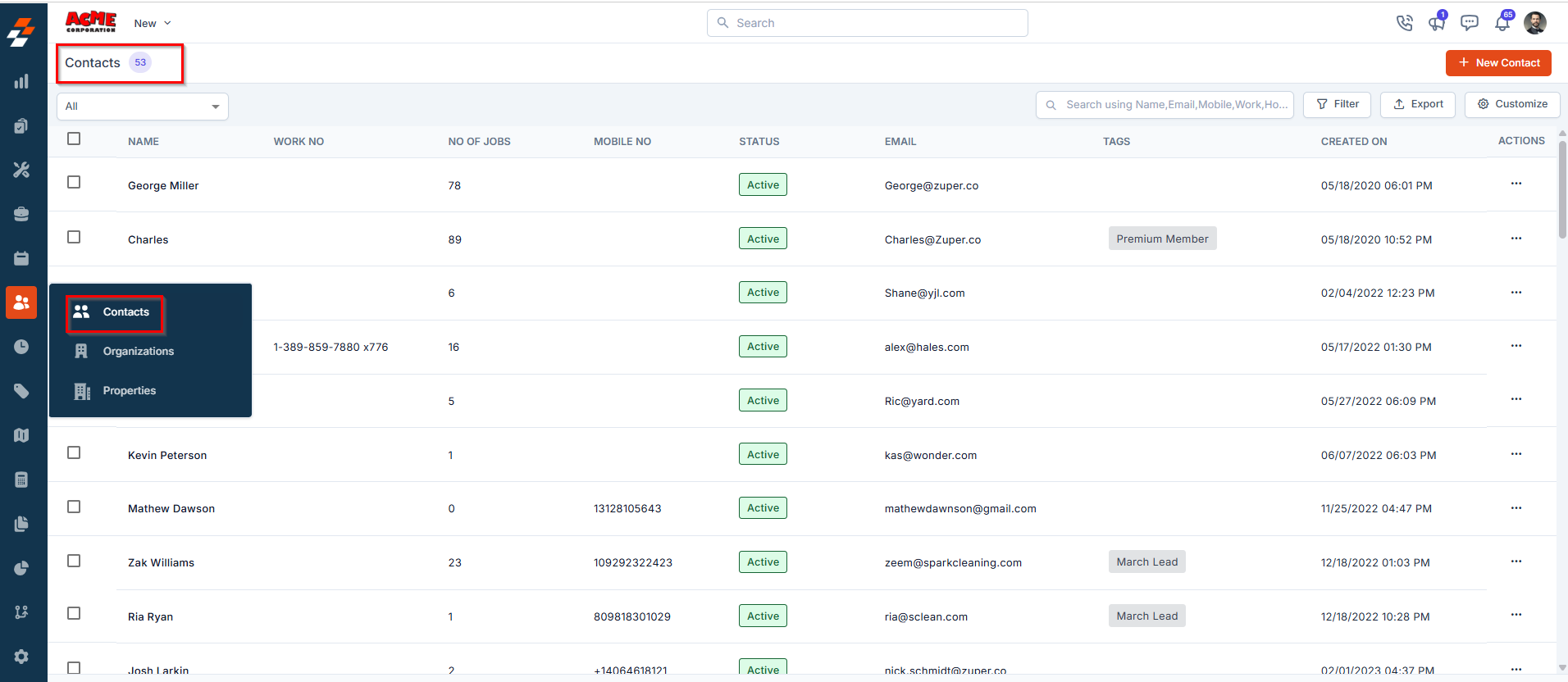
- Select the “Client” module from the left navigation menu and choose “Contacts.”
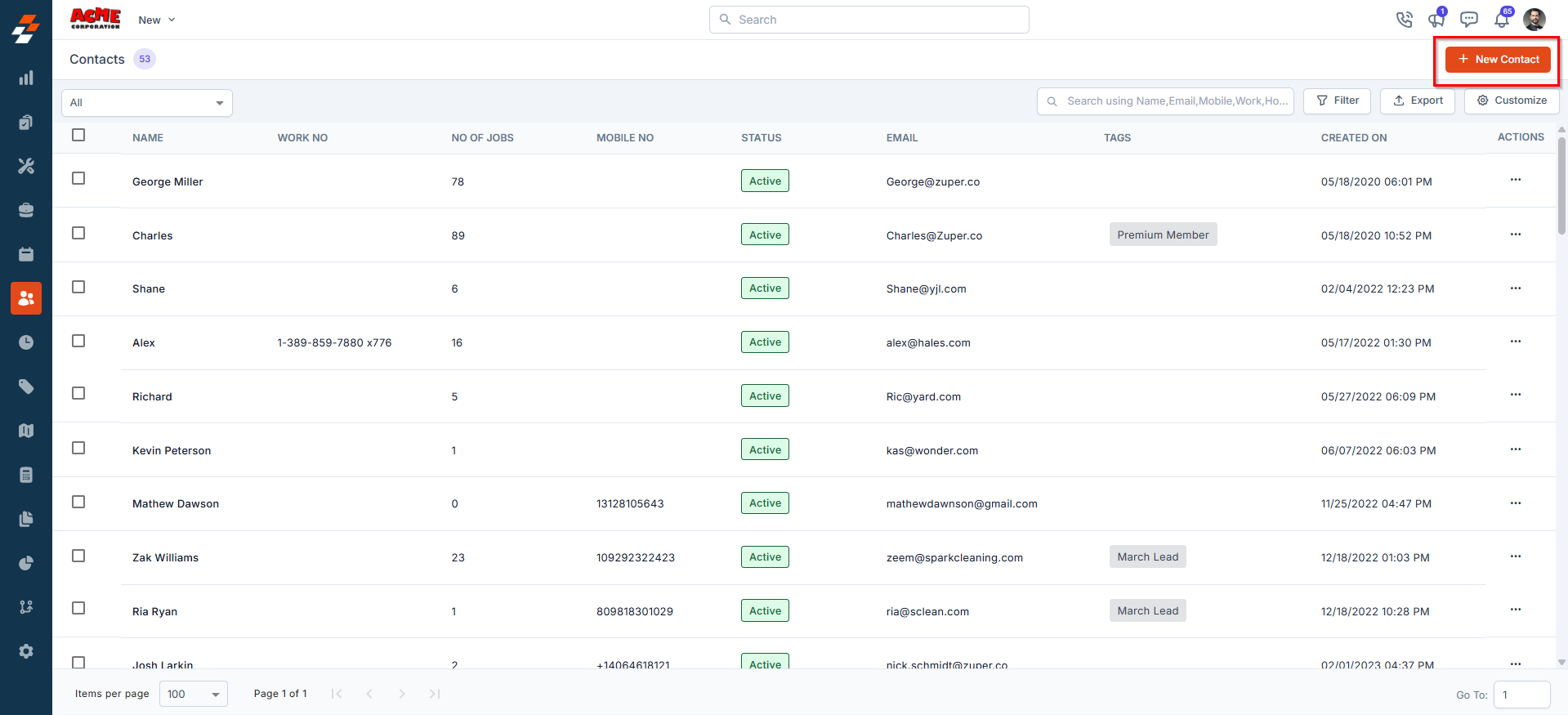
- You will land on the Listing page, which provides a comprehensive view of all your contacts with key information such as Contact Name, Status, Email, Work number, and more.
Exploring the listing page
The Customer/Contact Listing Page layout in Zuper includes view management, column selection, views, and saving customized views. This process is performed directly on the module’s listing page. Default Listing Behavior The system retains its existing default listing behavior, ensuring that pre-set configurations or default views are preserved. When you first access the Customer/Contact Module Listing Page, you’ll see the default view with columns such as Customer/Contact Number, Customer/Contact Address, Customer/Contact Tags, and Customer/Contact Status.Create view configuration
Selecting Columns You can choose which columns to display to focus on relevant data: 1. Select the “Customer/Contacts” module from the left navigation menu. You can view the listing page.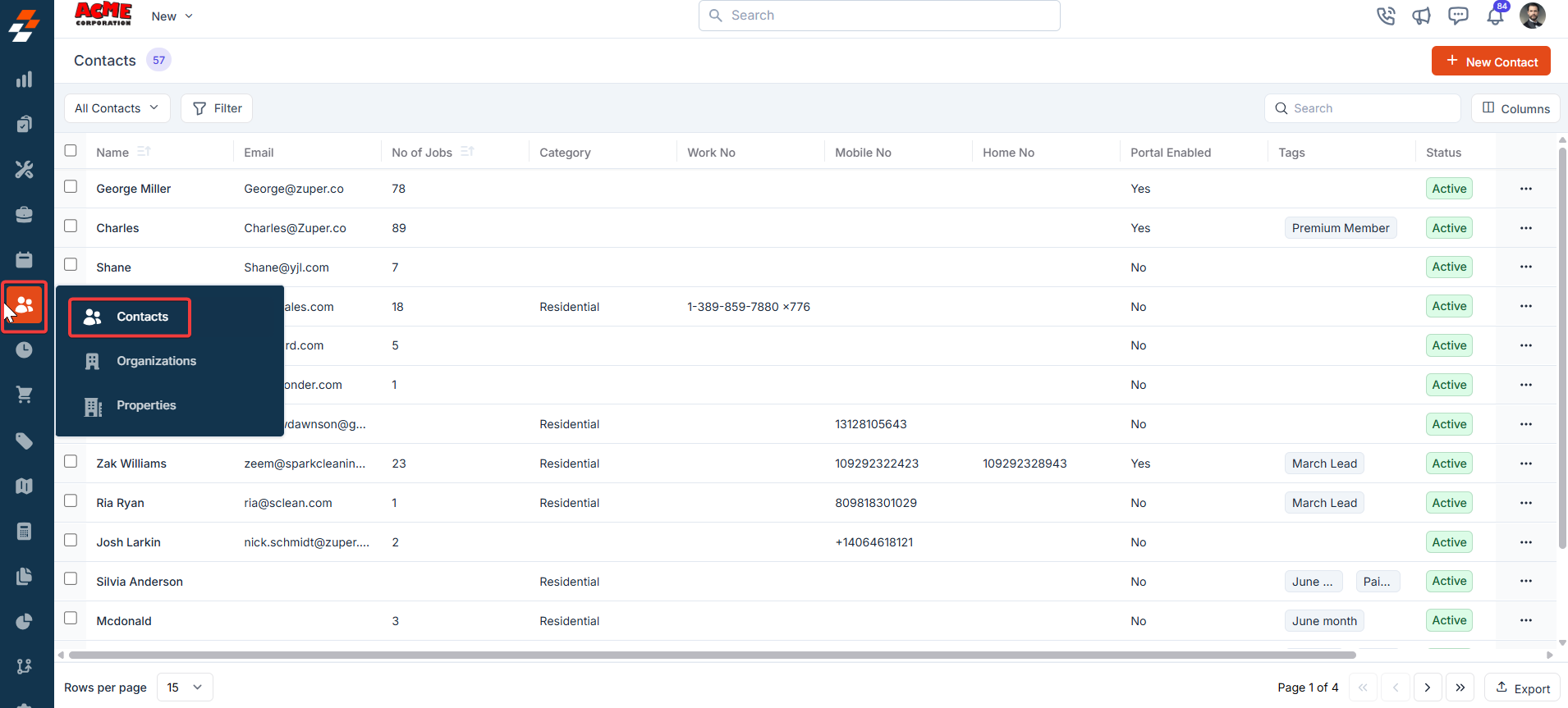
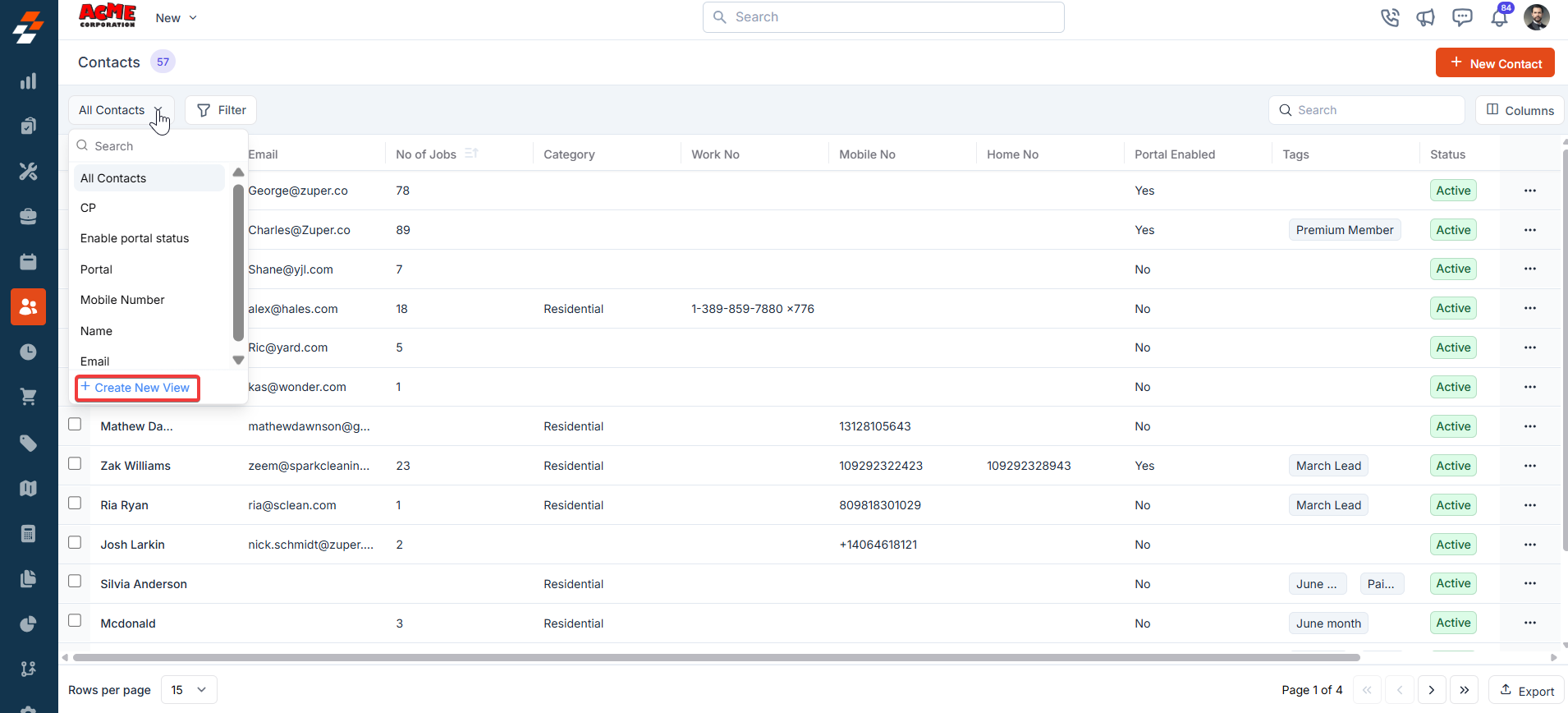
- From the “Views” list, click “+Create new view.”
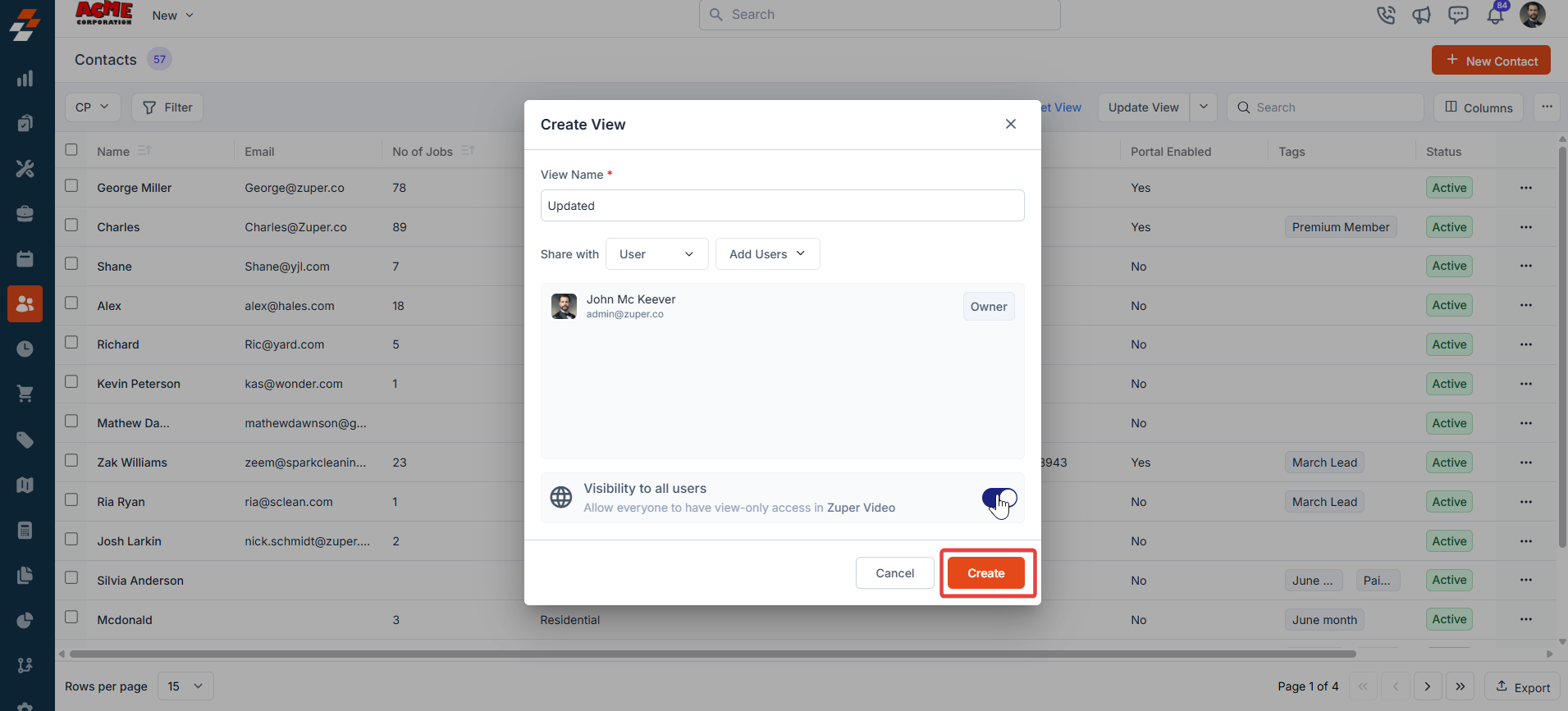
- A “Create View” dialog box appears.
- Once you click “Create,” the Columns sidebar appears, showing “Available Columns” and “Displayed Columns.” To add a column, drag it from the “Available Columns” list on the left to the “Displayed Columns” list on the right. You can click “Continue.”
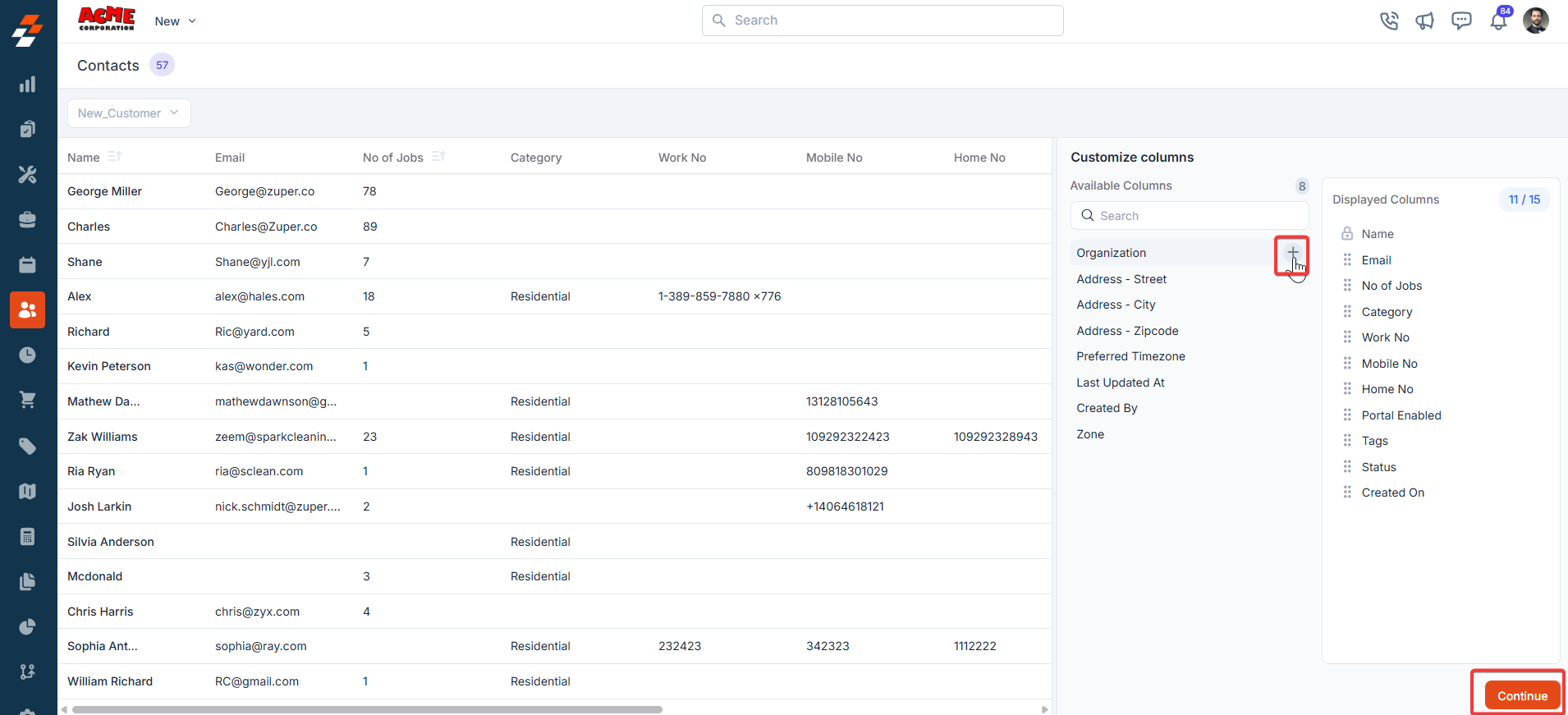
- To remove a column, drag it from the “Displayed Columns” list back to the “Available Columns” list or click the - next to the column name. Click Continue to apply the changes.
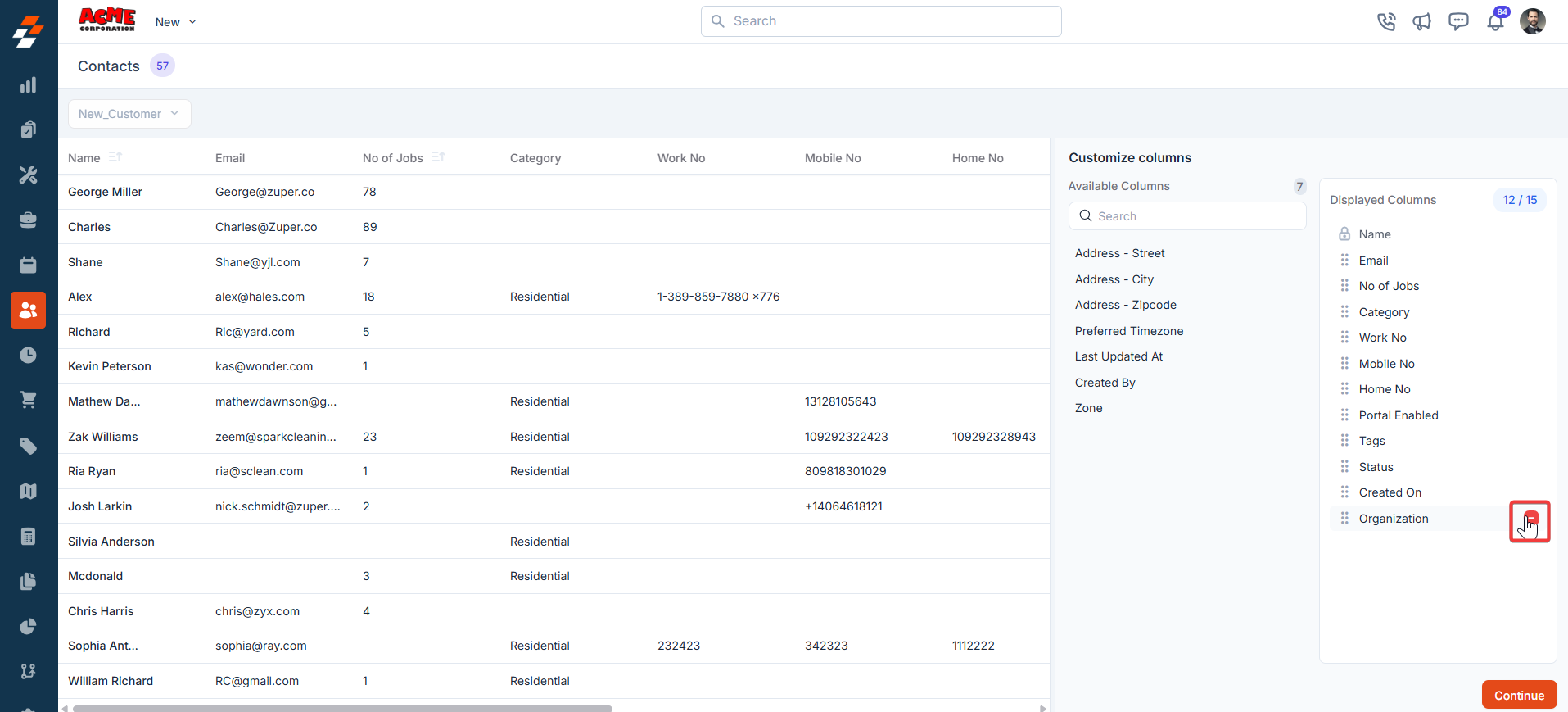
- If you wish not to add any filter, click “Skip and Save” to create the view.
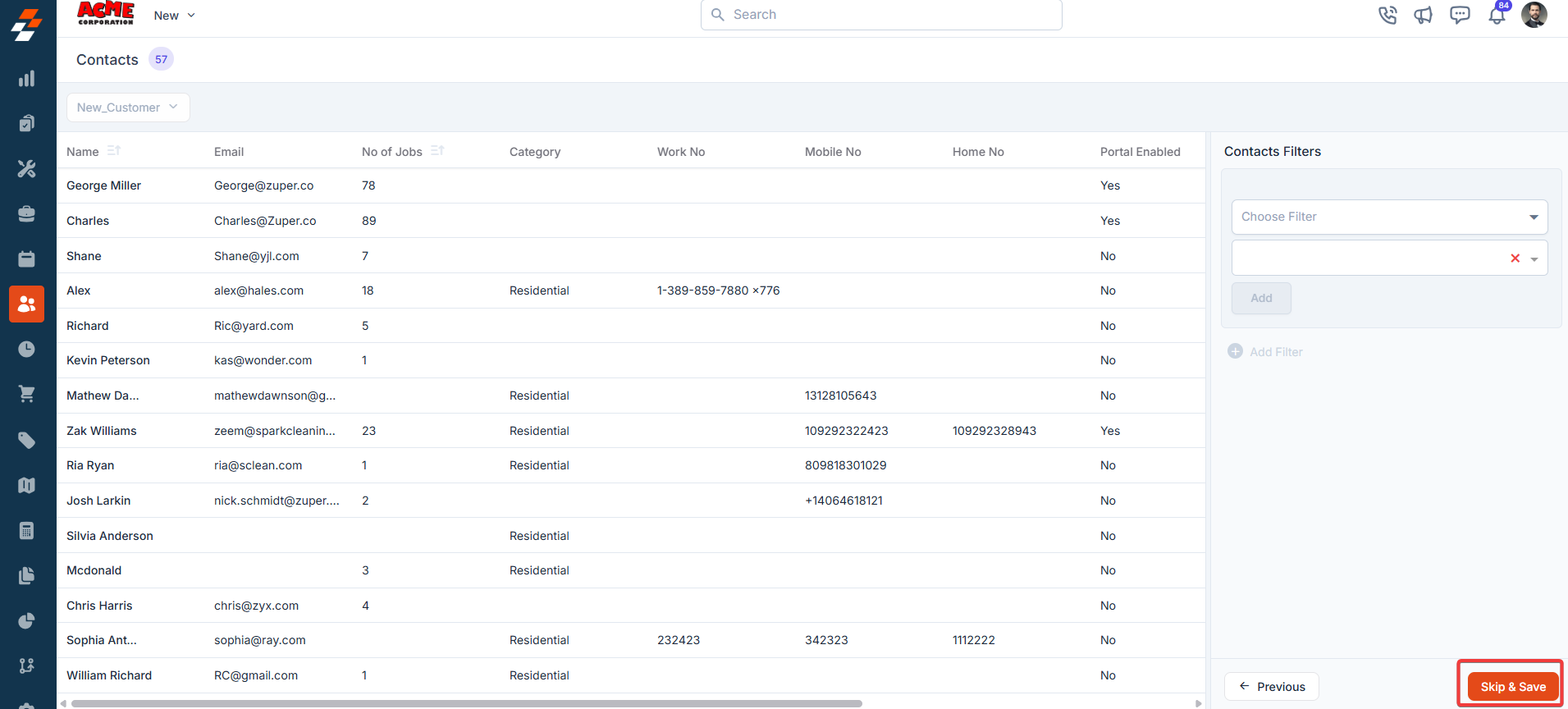
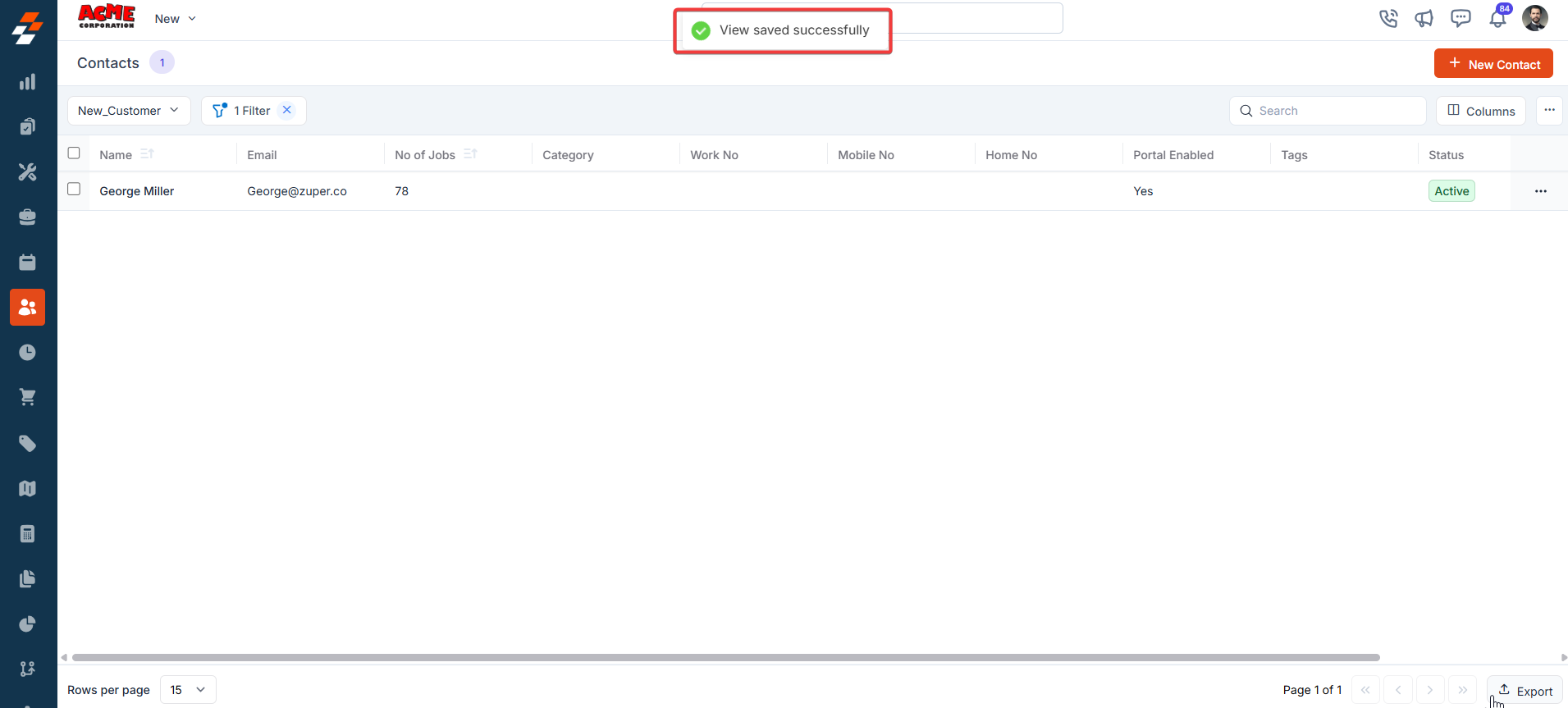
- The view is saved successfully.
Applying filters
The Filter feature lets you refine your view by applying multiple filters based on available attributes. For example, you can select an attribute like “Customer/Contact Status Type,” choose conditions such as “Equal to,” “Contains,” or “Does Not Contain,” and choose the desired value. Once the filter is applied, the results will update to show only the Customer/Contacts that meet your criteria, making it easier to find and manage relevant Customer/Contacts.- Click “Filter” at the top left of the page. Choose the attributes you want to filter by, apply the desired conditions, and click the “Add” button to view the results.
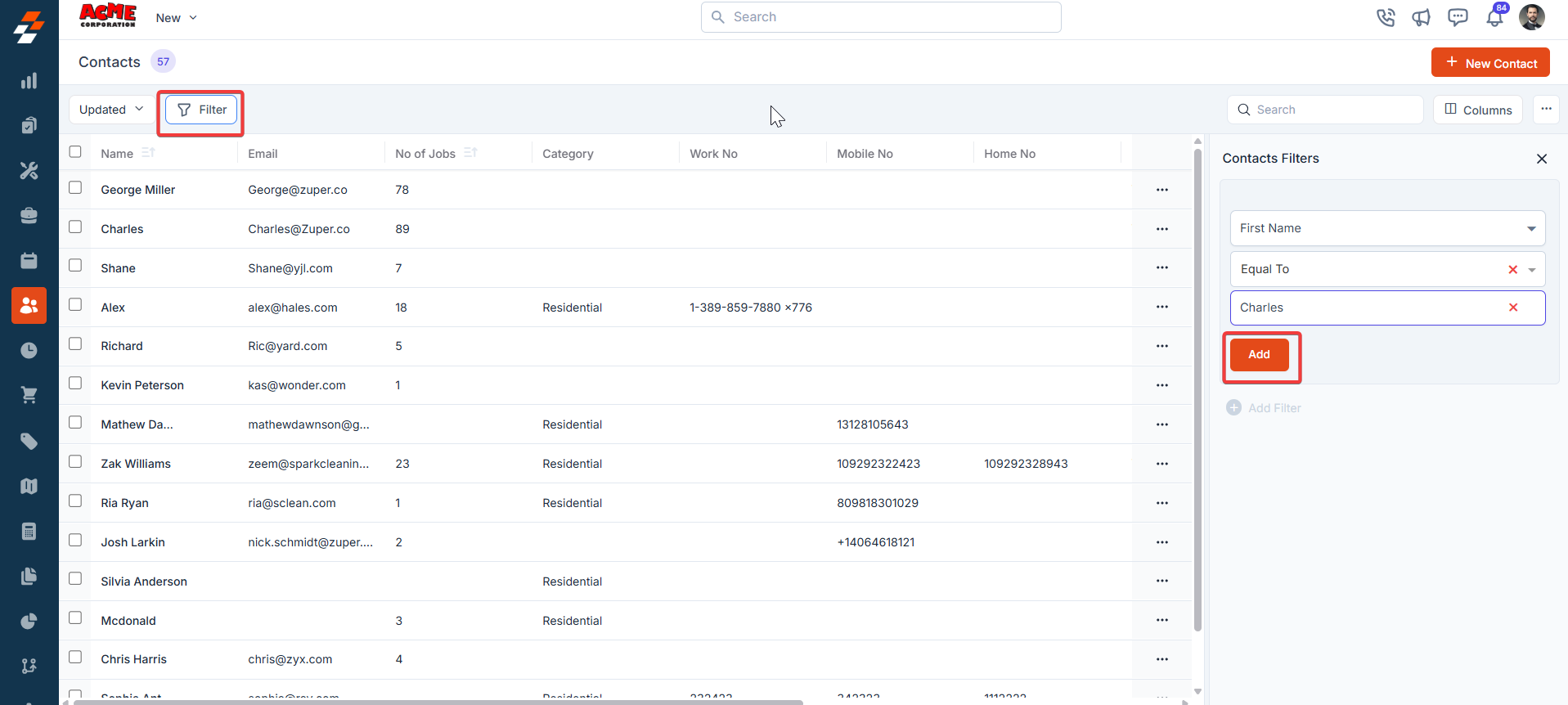
- Click “Update View” to modify the existing view.
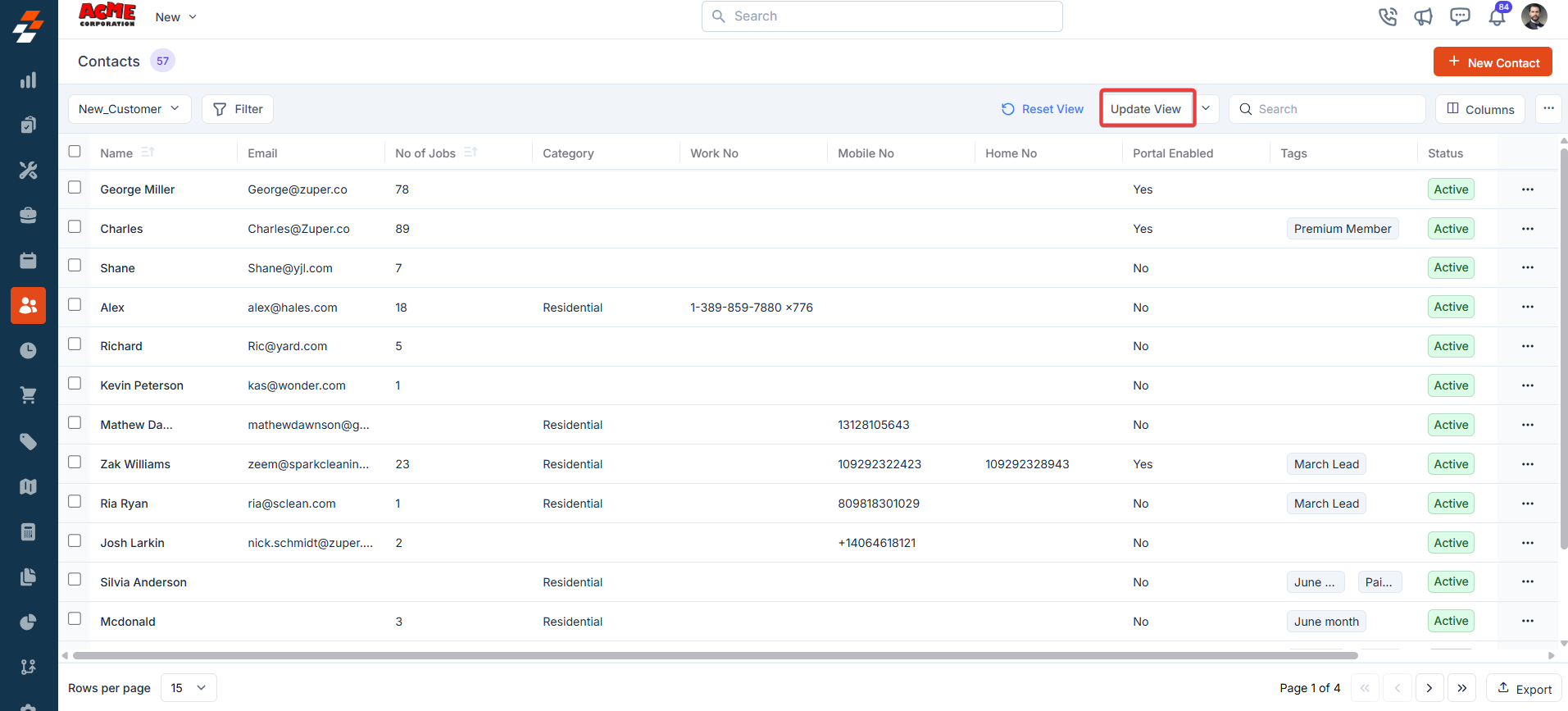
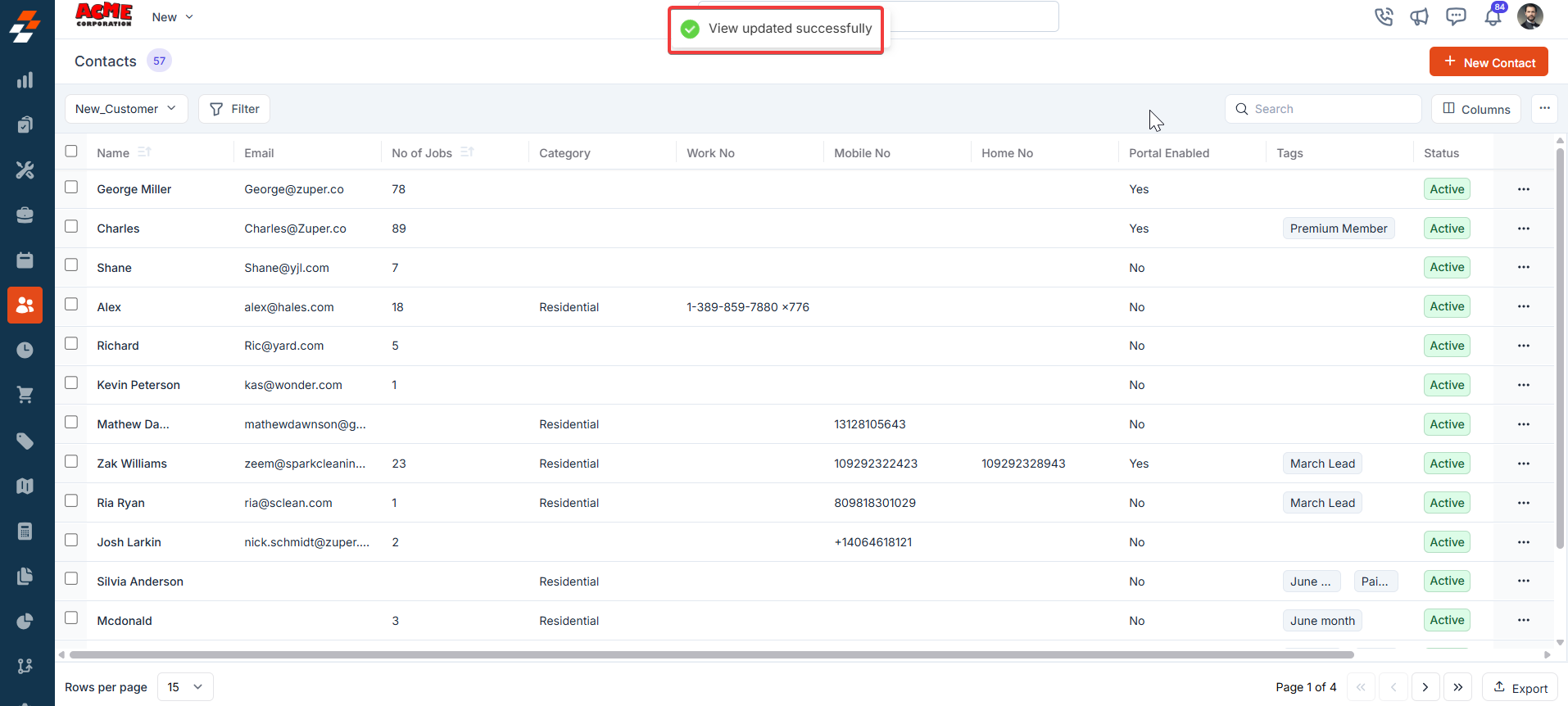
- The new view is set successfully with the filter. You can view the filter created and the filter name from the view list.
Update view
An update view allows you to modify the current display settings of the “Customer/Contacts” section. After making changes, you can save the updated configuration to the existing one or name it a new view.- Add/remove the existing columns and click “Update View” to modify the existing view.
- The view is updated successfully.
- Click the down arrow below the “Update View” to create a new view by clicking “Save as new view.”
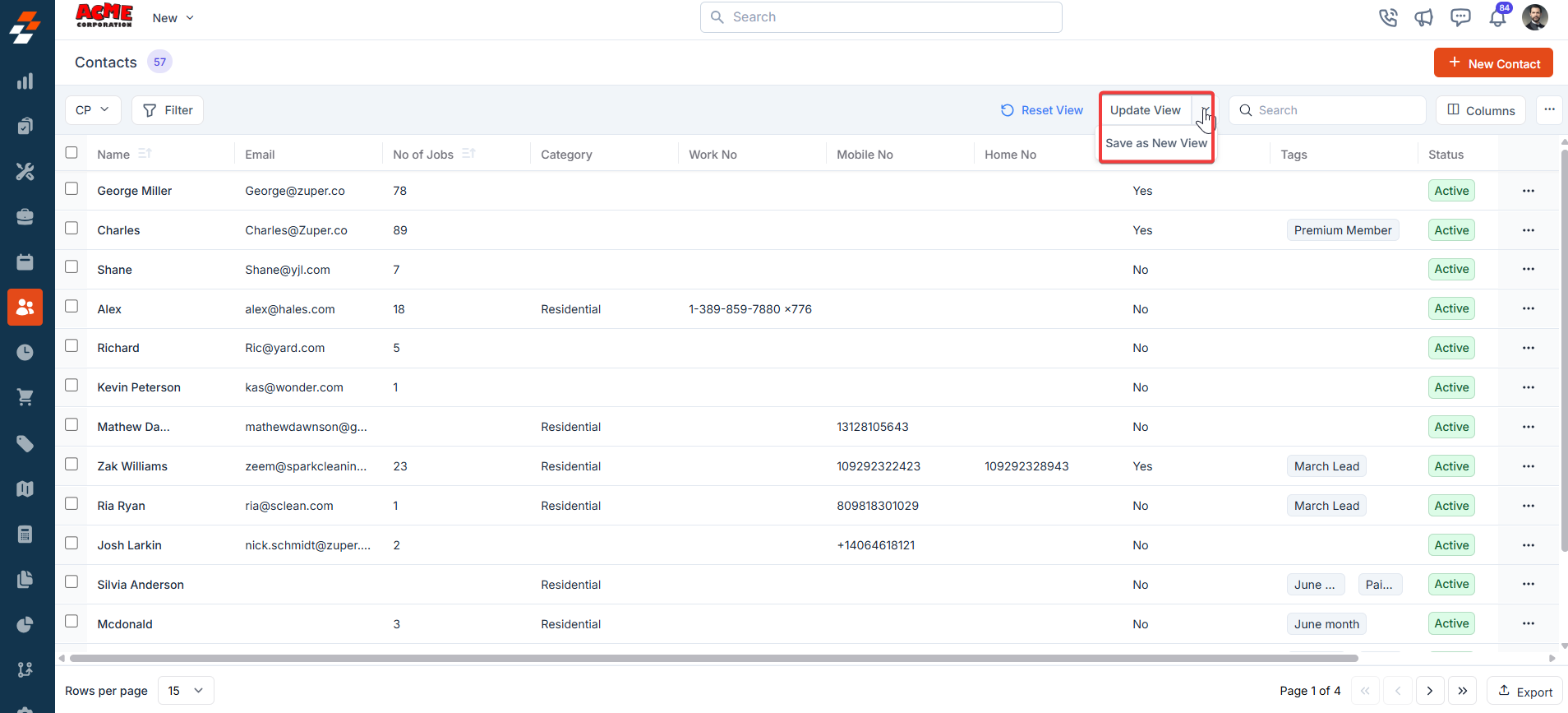
- A “Create View” dialog box appears.
- View Name (Mandatory) – Enter the view name.
- Share with - Select any one of the options (User, Team), and you can add the relevant users.
- Visibility to all users – Toggle on to make this view visible.
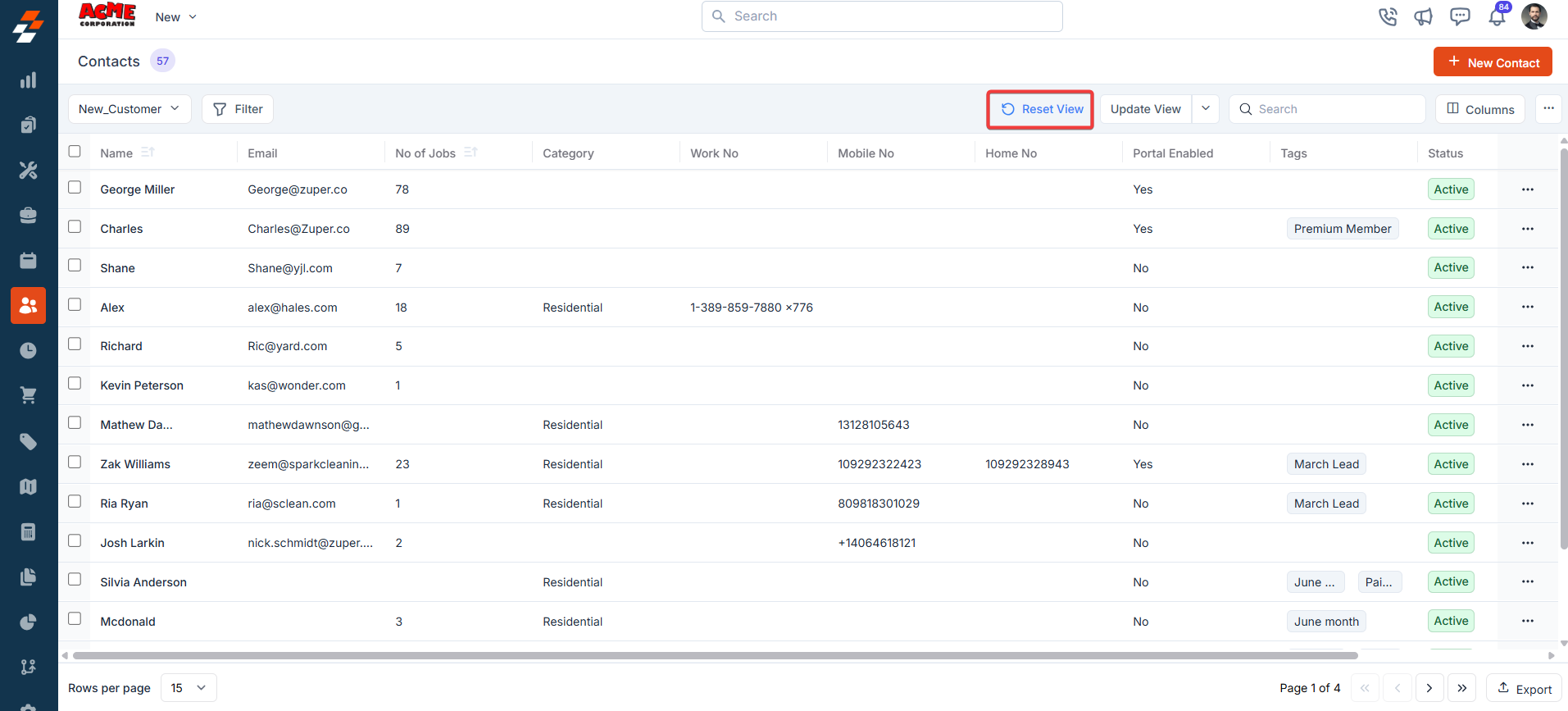
- Click “Reset View” to reset the current view.
Setting permissions for views
Edit Permissions
Users with edit permissions can modify the layout:- They can add/remove columns, reorder them, and adjust views as described above.
- If permission is given, changes can be saved as a new view or overwritten as an existing one.
View Permissions
Users with view-only permissions can see the layout but cannot make changes:- They can view the customized columns and filters but cannot edit them. To ensure consistency for viewers, they can save them as a new “View.”
Make changes to the view
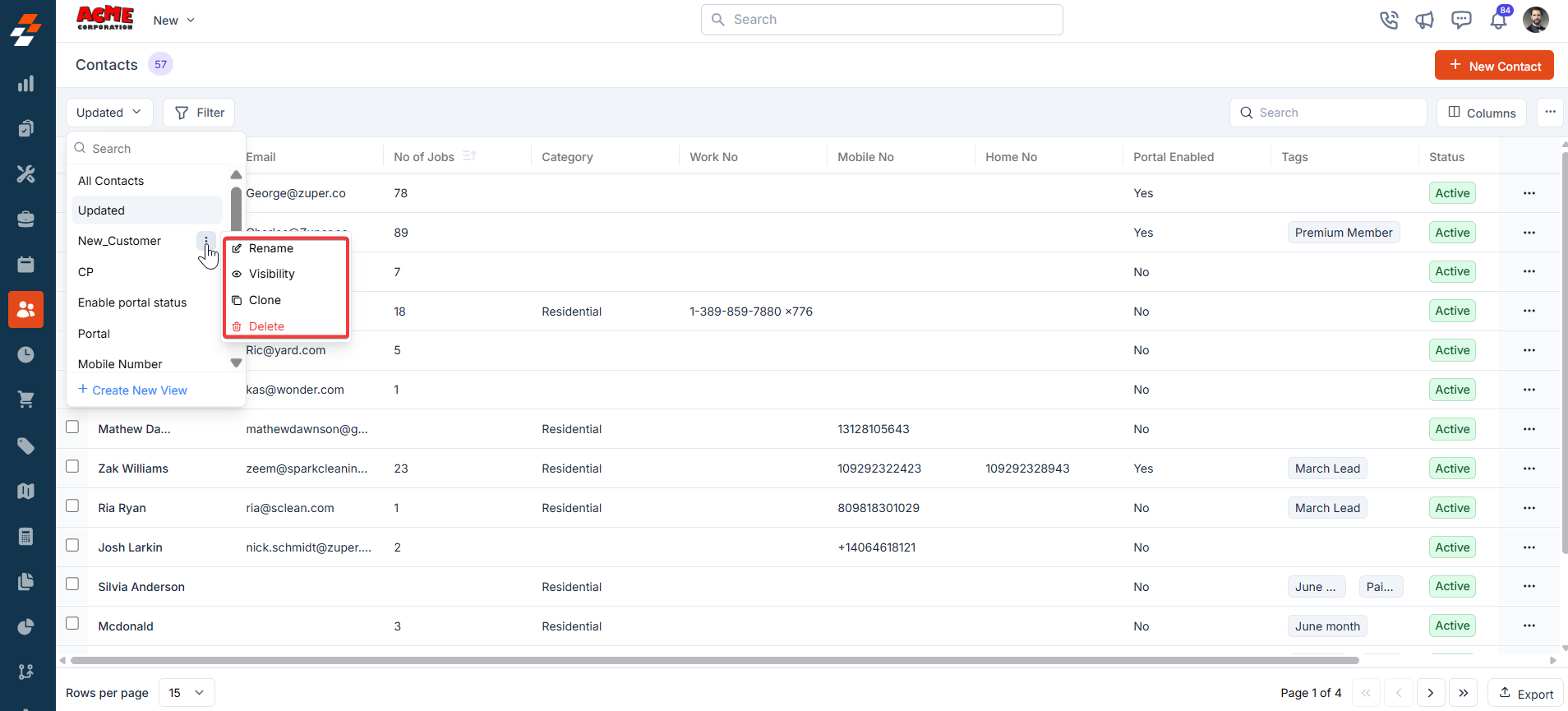
- Rename: This option allows you to change the view’s name (e.g., from “New_Customer” to something else).
- Visibility: This lets you adjust who can see the view. Options include sharing with a user or team or keeping it private (“Only Me”), as well as toggling visibility for all users in Zuper (as shown in the “Create a View” dialog in prior images).
- Duplicate: This function creates a copy of the “New_Customer” view, allowing you to modify the duplicate without affecting the original.
- Delete: Removes the view entirely. Since this is a custom view, deleting it would revert the listing to the default view or another saved view. Only the created user can delete the view.
Pinned filters
Zuper’s Customers module lets you use pinned filters to streamline your filter experience. Pinned filters keep your most-used criteria readily accessible for quick application. Pin up to 3 filters in any module.Navigation: Clients -> Customers -> Filters -> Pinned Filter
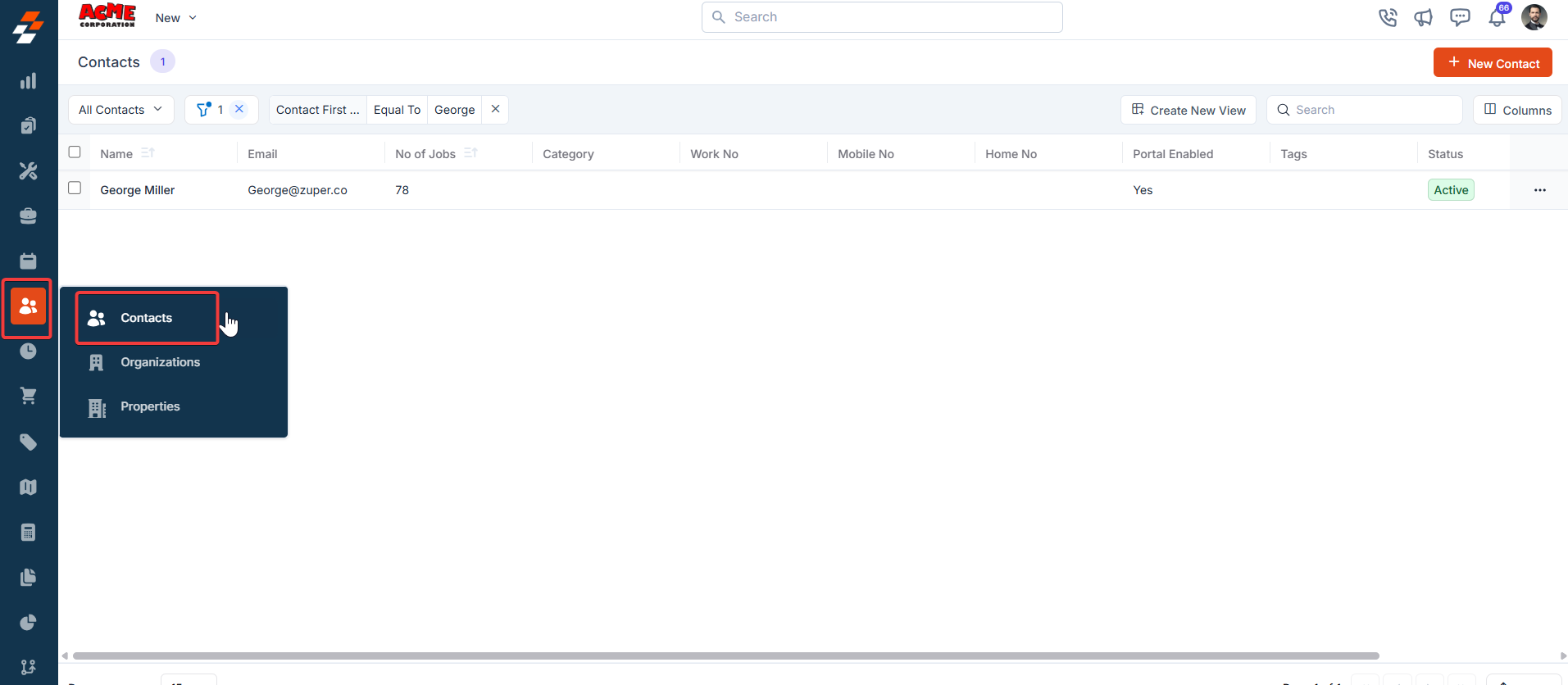
- Select the “Clients” module from the left navigation menu. Choose the “Customers/Contacts.”
- Pin Filters for Quick Access
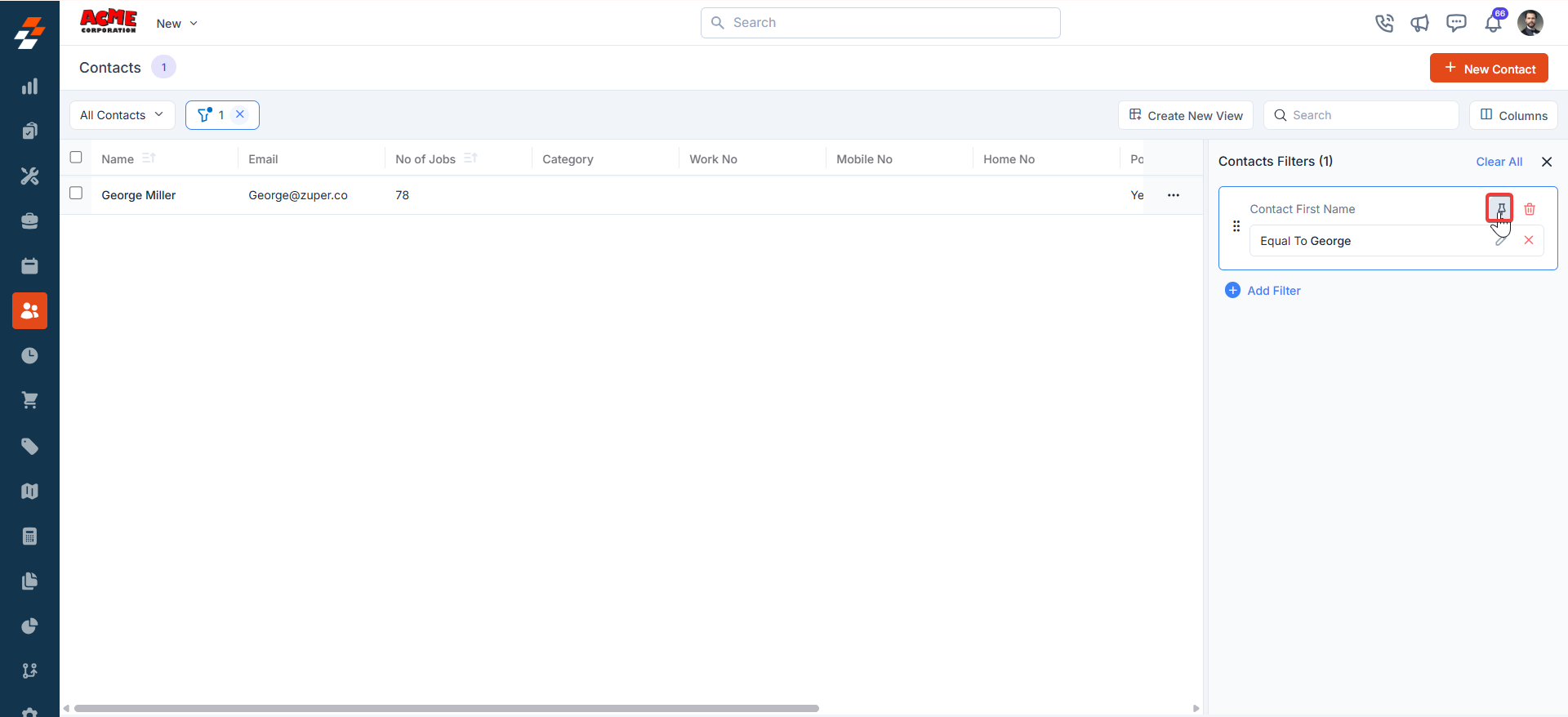
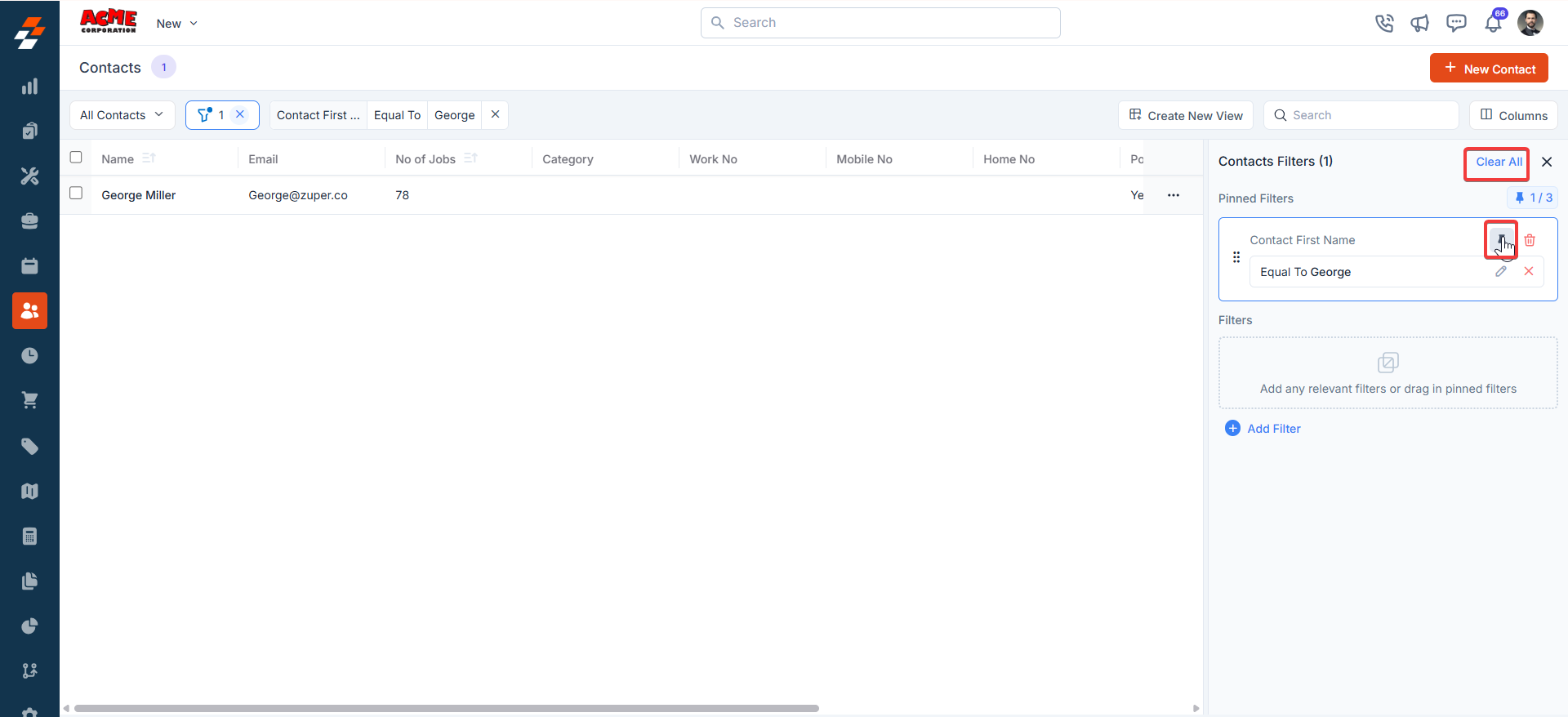
- Once your filters are set, click the Pin Filters button in the dialog box to save them as pinned.
- Pinned filters appear in the dialog box’s “Pinned Filters” section, allowing you to apply them with one click in future sessions.
- To Unpin the filter:
- To unpin, select a pinned filter and click Remove.
- To apply pinned or default filters, open the dialog box and select them.
- Use Clear All to remove active filters.
Creating a new contact
You can quickly create a new contact directly from the listing page.- Click the ”+ New Contact” button in the top right corner.
- Fill in the required fields such as Contact Name, Contact Information, Tax Details, and Service Addresses.
- For a step-by-step walkthrough, refer to the Creating a new contact article.
Managing contact details
Once you select a contact from the Contacts listing page, the Contact Details page opens. It provides a centralized workspace to view and manage contact information, associated records, recent activity, notes, and attachments. The page follows a three-panel layout consisting of the left panel, center panel, and right panel.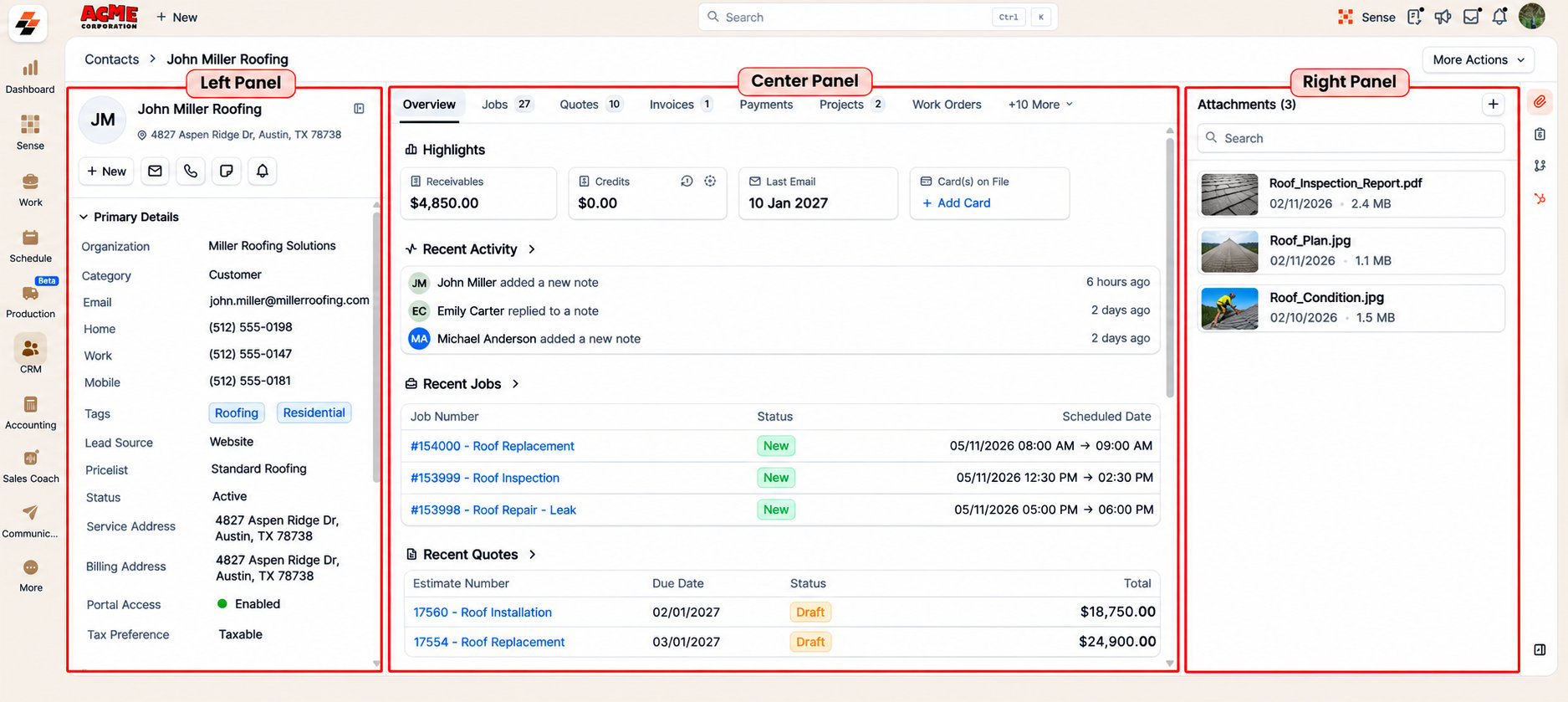
Left Panel- Contact Information
The left panel displays the contact’s basic information and provides quick access to commonly used actions. At the top of the panel, you can view the contact’s name and address. You can also access quick actions to create a related record, send an email, make a call, add a note, or perform other contact-related actions. Below the contact information, the Primary Details section displays key information, including:- Organization: The organization associated with the contact.
- Category: The category assigned to the contact.
- Email: The contact’s email address.
- Home: The contact’s home phone number.
- Work: The contact’s work phone number.
- Mobile: The contact’s mobile number.
- Tags: Tags associated with the contact.
- Lead Source: The source from which the contact was acquired.
- Pricelist: The pricelist associated with the contact.
- Status: The current status of the contact.
- Service Address: The address where services are provided.
- Billing Address: The contact’s billing address.
- Portal Access: Indicates whether the contact has access to the customer portal.
- Tax Preference: Displays the contact’s tax preference.
Center Panel – Contact Workspace
The center panel provides access to contact-related information through different tabs. These tabs help you view and manage records associated with the contact.Overview
Overview
The Overview tab provides a summary of the contact’s information, including key highlights, recent activity, and associated records.You can view the following sections:
- Highlights: Displays key financial and communication information, such as receivables, credits, and the last email date.
- Recent Activity: Shows the latest actions and updates performed on the contact.
- Recent Jobs: Displays jobs associated with the contact, including job numbers, statuses, and scheduled dates.
- Recent Quotes: Displays quotes created for the contact, along with their estimate numbers, due dates, statuses, and total amounts.
- Recent Invoices: Displays invoices associated with the contact and their details.
Jobs
Jobs
The Jobs tab displays all jobs associated with the contact. You can review job details, track their statuses, and access individual job records.
Quotes
Quotes
The Quotes tab displays quotes created for the contact. You can review estimate numbers, due dates, statuses, and total amounts.
Invoices
Invoices
The Invoices tab displays invoices associated with the contact, helping you review billing records and payment statuses.
Payments
Payments
The Payments tab displays payments received from the contact, allowing you to review payment-related records.
Projects
Projects
The Projects tab displays projects associated with the contact. You can access the project records to review their details and track progress.
Work Orders
Work Orders
The Work Orders tab displays work orders associated with the contact, allowing you to review and manage related service work.
Material Orders
Material Orders
The Material Orders tab displays material orders associated with the contact, helping you track requested materials and their fulfillment.
Requests
Requests
The Requests tab displays service requests raised by the contact. You can review and manage the requests from this section.
Communication
Communication
The Communication tab displays communication records associated with the contact, such as emails and calls.
Assets
Assets
The Assets tab displays assets associated with the contact, providing access to their related records.
Contracts
Contracts
The Contracts tab displays contracts linked to the contact, allowing you to review the associated agreements.
Properties
Properties
The Properties tab displays properties associated with the contact. You can access these records to view property-related information.
Outbound Logs
Outbound Logs
The Outbound Logs tab displays logs of outbound communications sent to the contact.
Notes
Notes
The Notes tab displays notes added to the contact. You can add comments, reminders, or supporting information and review existing notes.
Activity
Activity
The Activity tab provides a chronological history of actions and updates performed on the contact. It helps you track changes and monitor contact-related activities.
Gallery
Gallery
The Gallery in Contacts includes photos and videos associated with the contact, bringing all contact-related media into one unified view. You can browse, filter, and organize media uploaded across jobs linked to the contact.For more information about the available Gallery actions, see the Jobs Gallery article.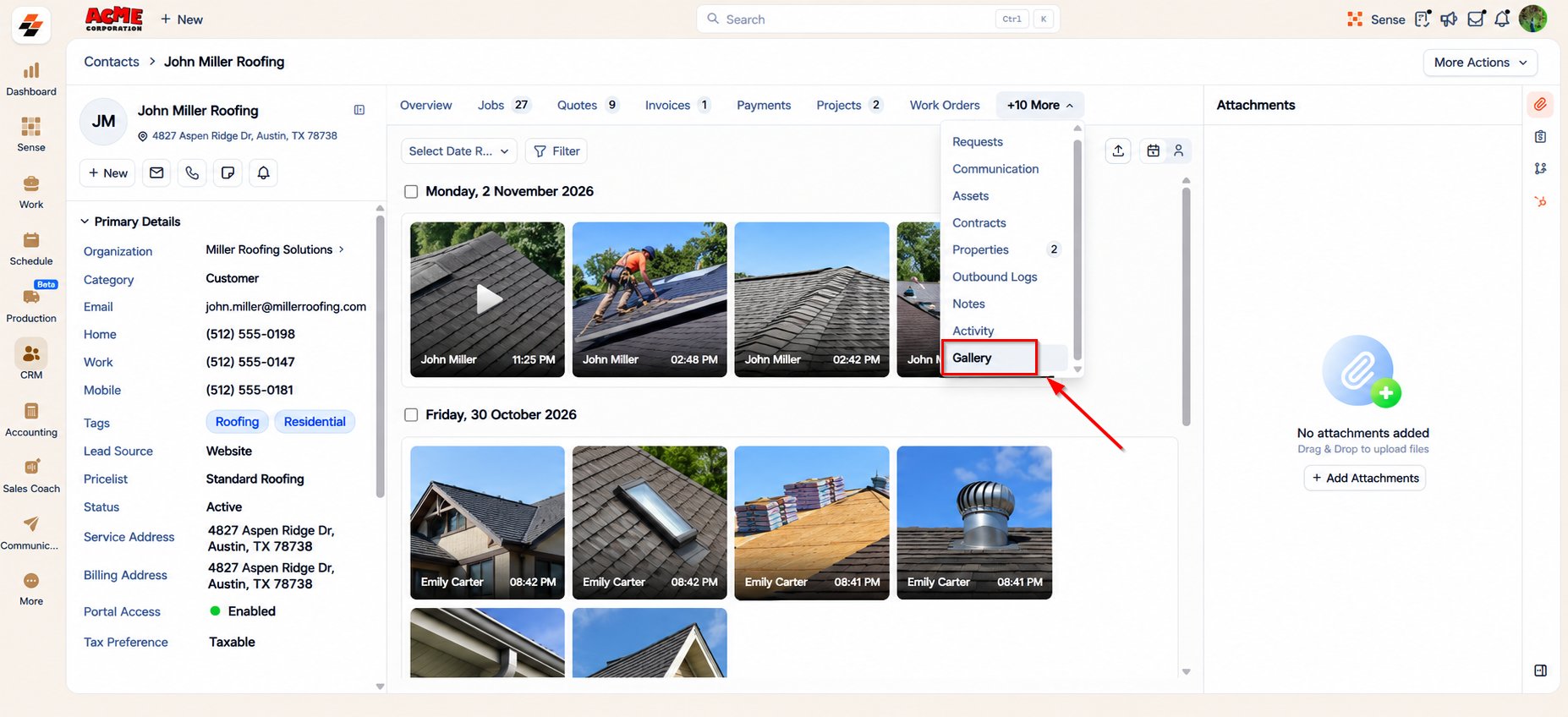
Note: Photos and videos added to a job’s Gallery are also available in the associated customer’s Gallery. However, media uploaded directly to the customer’s Gallery is not automatically associated with jobs created for that customer. When you select Filter > Show Related in the Job’s Gallery, all media uploaded directly to the customer’s Gallery is also displayed.
Right panel
The right panel displays files attached to the contact. You can view existing attachments and upload additional files using the + icon or the Add Attachments button.More actions
The More Actions menu at the top-right corner of the page provides additional options for managing the contact. The available actions include: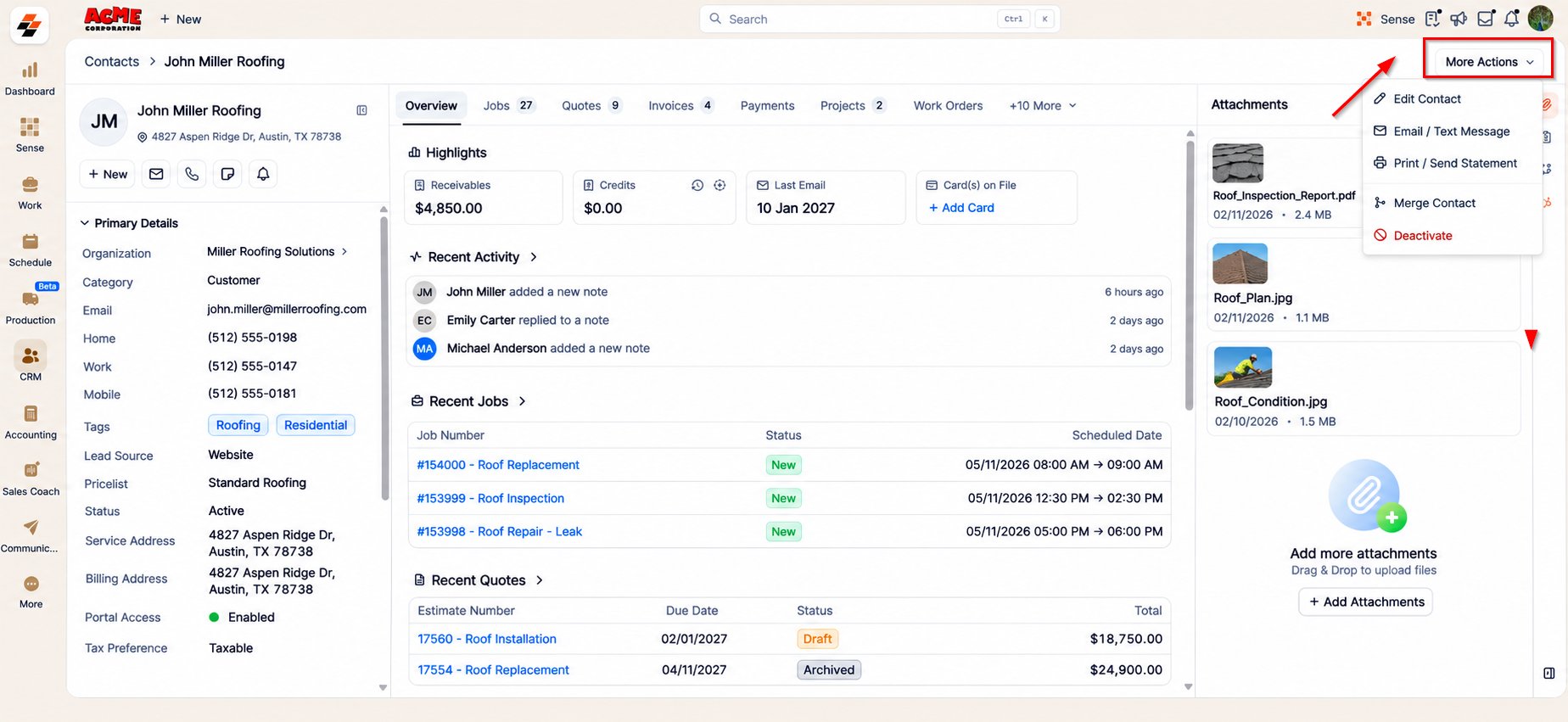
Edit Contact
Edit Contact
Update the contact’s information, such as name, email, phone numbers, or associated organization.
Updating a contact’s email does not update existing jobs.When you change the email address on a contact profile, Zuper saves the new email on the profile only. Jobs that were already created keep the original email address in their service contact details. You must update each existing job manually to reflect the new email.
Email/Text
Email/Text
Instantly send an email or text to the contact directly from the system for quick communication.
Print/Send Statement
Print/Send Statement
Generate and share a print-friendly version of the contact’s financial statement, including invoices and payment history.
Merge Contact
Merge Contact
Combine duplicate contacts into a single profile to avoid redundancy and maintain clean records.
Deactivate
Deactivate
Temporarily disable a contact without deleting their data, preserving historical information for future reference. Once deactivated, you will have the option to activate or delete the contact.
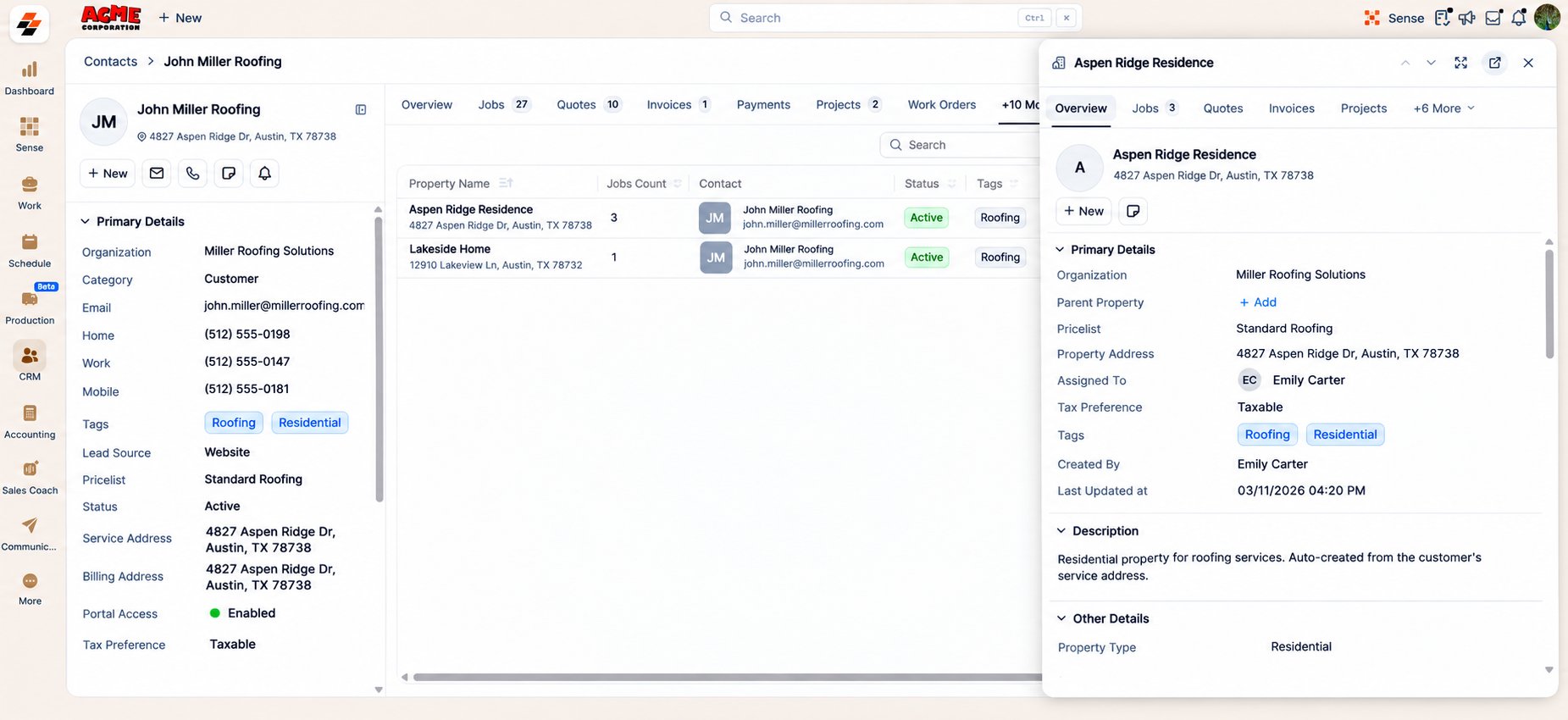
View Auto-Created Property
When Auto-Create Property is enabled, Zuper automatically creates a property record when you save a contact with a valid service address. You don’t need to create or associate the property manually. To view the auto-created property:- Open the contact details page.
- Locate the Properties tab.
- Select the property to view its details. A quick-view panel opens showing the property name, location, number of jobs, and associated contacts. This is a good way to get a summary without leaving the page.
- To see the full property record, select View details in a new tab in the quick-view panel.
FAQs
I updated a contact's email address. Why do my existing jobs still show the old email?
I updated a contact's email address. Why do my existing jobs still show the old email?
Zuper saves the new email on the contact profile only. It does not automatically apply the change to jobs that were created before the update. Each existing job stores its own copy of the service contact details at the time the job was created.To update the email on an existing job, open the job and edit the service contact details directly. You must do this for each affected job individually.If the issue continues, contact Support.
Why did an SMS notification reach the wrong person?
Why did an SMS notification reach the wrong person?
SMS notifications are delivered to the phone number saved on the contact record. If the same number is saved on more than one contact — for example, on both a primary customer and a secondary contact — the message is delivered to whoever owns that number, while the message content and outbound log continue to reference the primary customer.To prevent messages reaching an unintended recipient, make sure each contact record holds only that contact’s own phone number, and check for duplicate numbers across related contacts.